Key Characteristics:
-
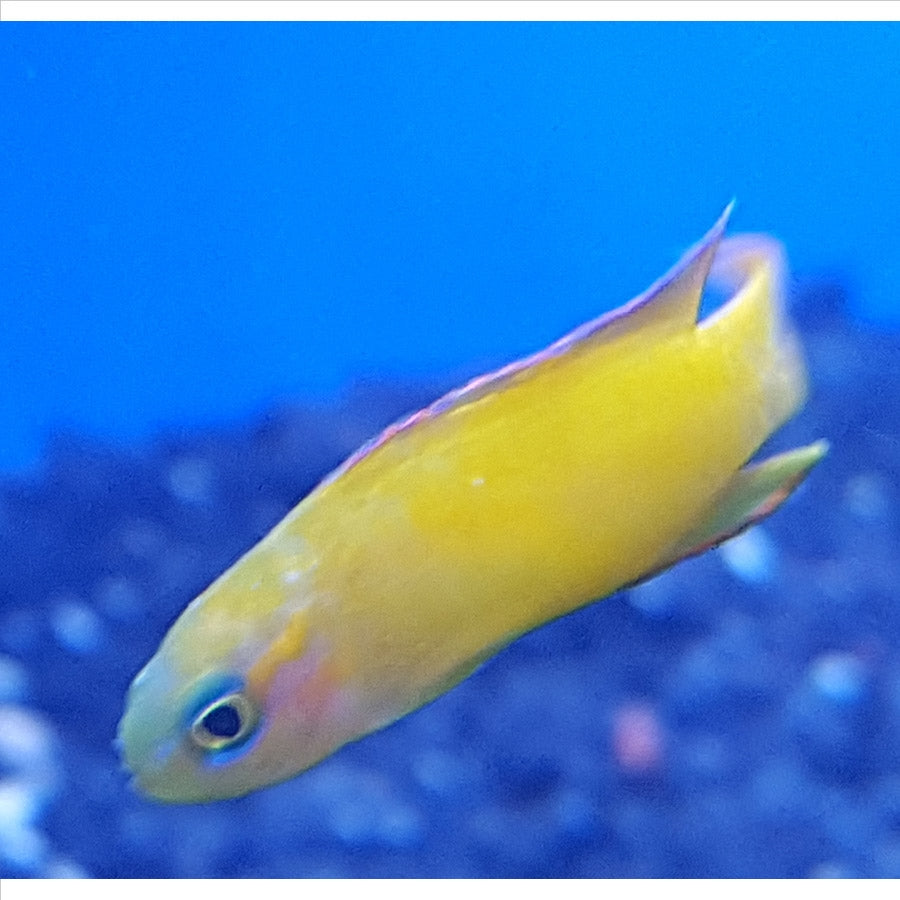
Vibrant Coloration: As its name suggests, the Yellow Assessor is a striking, bright yellow all over its body. It often has reddish-orange outlines on its dorsal and anal fins, and sometimes a subtle reddish-orange stripe from the eye to the gill cover.
-
Size: They are relatively small fish, growing to about 5.5 - 7.6 cm (2.2 - 3 inches) in length.
-
Unique Swimming Behavior: One of their most fascinating traits is their tendency to swim upside down, especially when under ledges, in caves, or in crevices. This is a natural adaptation to their preferred habitat.
-
Temperament: They are generally considered peaceful to moderately peaceful, especially compared to some dottybacks (though they are not actually dottybacks; they belong to the family Plesiopidae, or "prettyfins"). They can be territorial, especially towards other assessor species or similar-looking fish, and particularly if they establish a specific crevice as their home.
-
Lifespan: With good care, they can live for several years in a home aquarium.
Habitat and Distribution:
-
Natural Range: The Yellow Assessor is native to the Western Central Pacific, with its distribution including the Great Barrier Reef in Australia, Papua New Guinea, and areas around Indonesia and the Philippines.
-
Preferred Environment: In the wild, they inhabit coral reefs, favoring caves, crevices, and underhangs. They often form small groups in these sheltered areas.
Diet and Feeding:
-
Carnivorous/Planktivore: Their natural diet consists primarily of small zooplanktonic crustaceans.
-
Aquarium Diet: They are generally not difficult to feed in captivity. Offer a varied diet of:
- High-quality marine flakes and pellets.
- Frozen foods such as mysis shrimp, brine shrimp (preferably enriched), cyclops, and finely chopped marine seafood (like squid or fish).
-
Feeding Frequency: Feed small amounts 2-3 times a day to ensure they get enough food and to reduce potential competition.
Aquarium Care:
-
Tank Size: A minimum of 30 gallons (around 100 liters) is recommended for a single Yellow Assessor. If you plan to keep multiple individuals, a larger tank (55+ gallons) with ample hiding places is necessary to minimize aggression.
-
Water Parameters:
-
Temperature: 22-26°C (72-79°F)
-
pH: 8.1-8.4
-
Salinity: 1.020-1.025 specific gravity
-
Alkalinity (dKH): 8-12 dKH
-
Aquascaping: Provide plenty of live rock with numerous caves, overhangs, and crevices. This will allow them to exhibit their natural upside-down swimming behavior and establish territories.
-
Reef Safe: Yes, they are considered excellent additions to reef aquariums as they will not bother corals or most invertebrates.
-
Compatibility:
- Best kept as a single specimen unless in a very large tank with many hiding spots.
- Choose peaceful to semi-aggressive tankmates. Avoid very aggressive fish that might bully them, and also extremely timid fish that might be outcompeted for food or stressed by the assessor's activity.
- Good tankmates might include other peaceful gobies, blennies, wrasses, and some smaller damselfish (though be cautious with other damselfish).
- Avoid keeping them with their close relatives, the Blue Assessor (Assessor macneilli), in smaller tanks, as territorial disputes are highly likely.
- As with any fish, monitor interactions carefully when introducing new inhabitants.
-
Maintenance: Regular water changes and consistent water quality are essential for their health.
Breeding:
- Like their blue counterparts, Yellow Assessors are mouthbrooders, with the male typically guarding the eggs in his mouth.
- While not commonly bred in home aquariums, captive breeding has occurred.